Thailand Convention & Exhibition Bureau (TCEB)

Isan Creative Festival: When “Muan” Becomes the Creative Economic Power of Isan

The Isan Creative Festival demonstrates that a local festival can be more than a showcase or marketplace. By connecting creativity with culture, communities, entrepreneurs, and business networks, the spirit of “muan” can become a tangible force for regional economic development and new opportunities.

When people talk about festivals, many may picture fairs, vendors, performances, and crowds strolling through an event space. But the Isan Creative Festival has shown that a modern festival can be far more than that.

Rather than simply showcasing local culture, the festival serves as a platform that uses creativity to connect food, crafts, music, fashion, art, technology, and business. Together, these elements have become a tangible force for the creative economy, generating real value for the region.

From the familiar image of Isan, often associated with pla ra, mor lam, silk, and local traditions, the Isan Creative Festival takes these cultural roots, refreshes them, retells them, and develops them into products, services, experiences, and business opportunities that can connect with both national and international markets.

Article image 1

From a Local Festival to a Creative Economy Platform

The Isan Creative Festival began in 2021, initiated by the Northeastern Office of the Creative Economy Agency, or CEA, at a time when the COVID-19 pandemic remained a major challenge.

Yet the challenge was not only the pandemic itself. An equally important task was to shift local perceptions and help people understand that a festival does not have to be merely a marketplace or a short-term event. It can also serve as a tool for building a new business ecosystem for the city.

At the heart of the festival is the effort to connect “design” and “creativity” with Isan’s cultural capital, particularly in three key sectors: food, entertainment, and crafts. The goal is to transform what was once seen as traditional or local into contemporary and competitive economic opportunities.

Bringing Creativity into the Real City

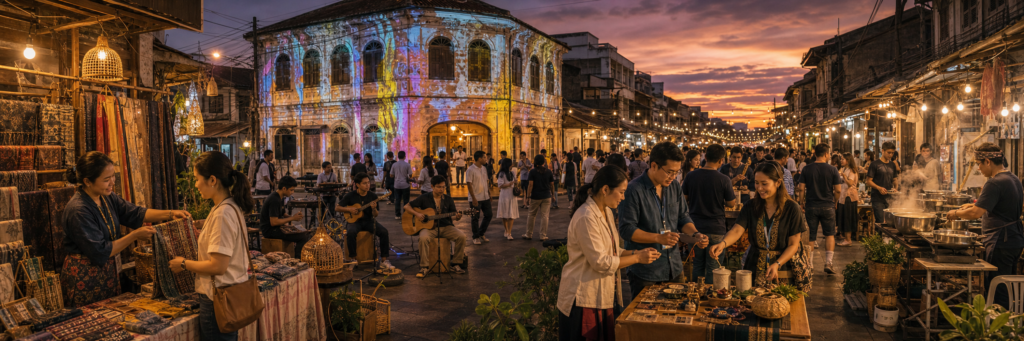
One of the distinctive strengths of the Isan Creative Festival is that it does not confine itself to galleries, conference rooms, or enclosed venues. Instead, it brings creative works into economic districts and real urban spaces where people live, work, and gather.

Projection mapping on old buildings, art installations in local shops, innovation showcases in community spaces, and the transformation of urban districts into learning and experimentation zones all allow local residents to see for themselves how creativity can attract people, generate activity, and stimulate business opportunities.

This is a crucial turning point. The festival is no longer just an event for audiences. It becomes a tool to awaken the potential of the city and its people at the same time.

Article image 2

A Tangible Isan Creative Power

When discussing Isan creative power, many people may think of pla ra, mor lam, silk, or local cuisine. But the Isan Creative Festival does not present these elements in the same old way. Instead, it reframes them and elevates cultural capital into something new with greater value.

A clear example is pla ra. Rather than treating it merely as a household seasoning, the festival positions it as a form of gastronomy creative power that can be developed into a premium ingredient for high-end cuisine. This is done through talks, workshops, and new bodies of knowledge built around local ingredients.

On the craft side, mudmee silk no longer remains only on the loom. It is extended into contemporary fashion, runway showcases, AI-supported design, and even digital assets such as NFTs.

These examples reflect a powerful truth. Effective creative power is not about imitating others. It is about taking one’s own roots and retelling them in a contemporary language, allowing people both inside and outside the region to rediscover the value of traditional culture.

Article image 3

When Mor Lam, Crafts, and Art Become Business

The Isan Creative Festival also demonstrates that a festival can become a serious business platform without losing its sense of fun, warmth, or local identity.

The idea of “muan mit”, meaning joy and friendship, becomes a business language within the Isan context. Rather than creating a rigidly formal atmosphere, the festival uses enjoyment, human connection, and shared experiences as tools to bring people together.

For example, the Isan Sound On Top platform brings promoters from various countries to experience mor lam and Isan indie music. This opens doors for local artists to connect with international markets. Meanwhile, the Film Fund Forum links Isan filmmakers directly with funding sources and buyers.

From a MICE perspective, this is a clear example of how a festival can be transformed into a space for business matching and relationship building. These connections take place naturally within an atmosphere shaped by local identity.

Numbers That Reflect the Power of the Creative Economy

The success of the Isan Creative Festival is not measured only by the number of visitors. It is also reflected in the economic value and business opportunities it creates.

According to information from the video, in 2025 the festival generated a total value of 686 million baht. Meanwhile, the Isan MICE Expo, organized in collaboration with TCEB, connected buyers, sellers, and businesses, resulting in more than 225 million baht in closed deals during the event.

In addition, art-focused programs such as Art Fest have helped prove that art can be both a source of inspiration and a real economic product. The number of participating studios has increased significantly, alongside actual art sales generated within the festival.

These figures show that when creativity is designed to connect with business systems, a festival can deliver outcomes that go far beyond entertainment. It can become a genuine mechanism for driving the urban economy.

Home Commerce: Creating Global Opportunities from Home

The deeper goal of the Isan Creative Festival is not simply to attract visitors. It is to build confidence among the younger generation in the region, especially Isan people who once felt they had to migrate to big cities in search of work or opportunity.

The festival seeks to prove that returning home does not mean reducing one’s life opportunities. With a strong support system, experimental spaces, business networks, and platforms that connect people to markets, staying in one’s hometown can still lead to business creation, career development, and international growth.

This concept makes the Isan Creative Festival more than a festival. It becomes a platform that helps young people see their future within their own hometowns.

Article image 4

The Next Step for the Isan Creative Festival

In 2026, the Isan Creative Festival moves forward under the concept of “North East Modern”. This concept reflects the confidence of a new generation of Isan, one that understands its roots, recognizes its own potential, and is ready to adapt to the future.

In this context, the word “dern” does not simply imply flamboyance or novelty. It represents courage, confidence, and the ability to transform cultural roots into new value in the modern world.

The Isan Creative Festival 2026 takes place from 11 to 19 July 2026 at KICE in Khon Kaen, marking another important step in demonstrating Isan’s potential as a creative region connected to the world.

A Festival Model Where TCEB Sees Opportunity

From the perspective of the MICE industry, the Isan Creative Festival is a clear example of how a festival can combine creativity, local culture, business negotiation, and the urban economy.

The event shows that MICE is not limited to meetings in conference rooms or exhibitions in convention halls. It can also take the form of a creative festival that connects people, cities, communities, entrepreneurs, artists, investors, and international markets.

When a festival is designed strategically, it can become a space for testing ideas, creating experiences, selling products, facilitating business negotiations, and building civic pride among people in the city.

Article image 5

What Can Isan Do?

The Isan Creative Festival shifts the question from “What does Isan have?” to a more powerful one: “What can Isan do?”

The answer is clear. Isan is not only rich in fascinating culture. It also has the potential to create businesses, generate value, build networks, and connect with the global market.

From pla ra to gastronomy creative power, from mudmee silk to fashion and NFTs, and from mor lam to the international stage, these examples reflect the power of creativity when it is rooted in cultural identity and connected to real economic opportunities.

The journey from local art to real sales, and from a regional festival to a creative hub, further demonstrates how cultural roots can be transformed into economic momentum when they are developed with understanding and strategy.

The Isan Creative Festival is therefore not merely a festival for Isan. It is proof that creative power rooted in one’s own identity can create economic value, generate opportunities, and bring Thailand to the global stage with confidence and grace.