Thailand as an Emerging Humanoid & Embodied AI Ecosystem
Thailand has long been recognised as one of the region’s major manufacturing bases, particularly in the automotive, electronics, high-precision components and automation industries. Technological developments in recent years, however, are creating new opportunities for these capabilities to extend into the next generation of industries: humanoid robots and Embodied AI.
Thailand has long been recognised as one of the region’s major manufacturing bases, particularly in the automotive, electronics, high-precision components and automation industries. Technological advances in recent years, however, are opening up opportunities for these capabilities to move into a new generation of industries: humanoid robotics and Embodied AI.
These industries require far more than robot assembly plants. They depend on an ecosystem that brings together mechanical components, electronics, drive systems, sensors, software, AI, system developers, and environments where technologies can be tested and deployed in real-world applications.
The significance lies not in positioning Thailand as a major robot producer overnight, but in the country’s ability to build on its existing industrial base and move into new segments of the value chain — from component manufacturing to intelligent automation, and from producing hardware to integrating hardware with software, AI, system integration and real-world applications.
This marks the beginning of a broader transition from “Made in Thailand” towards “Intelligence in Thailand”.
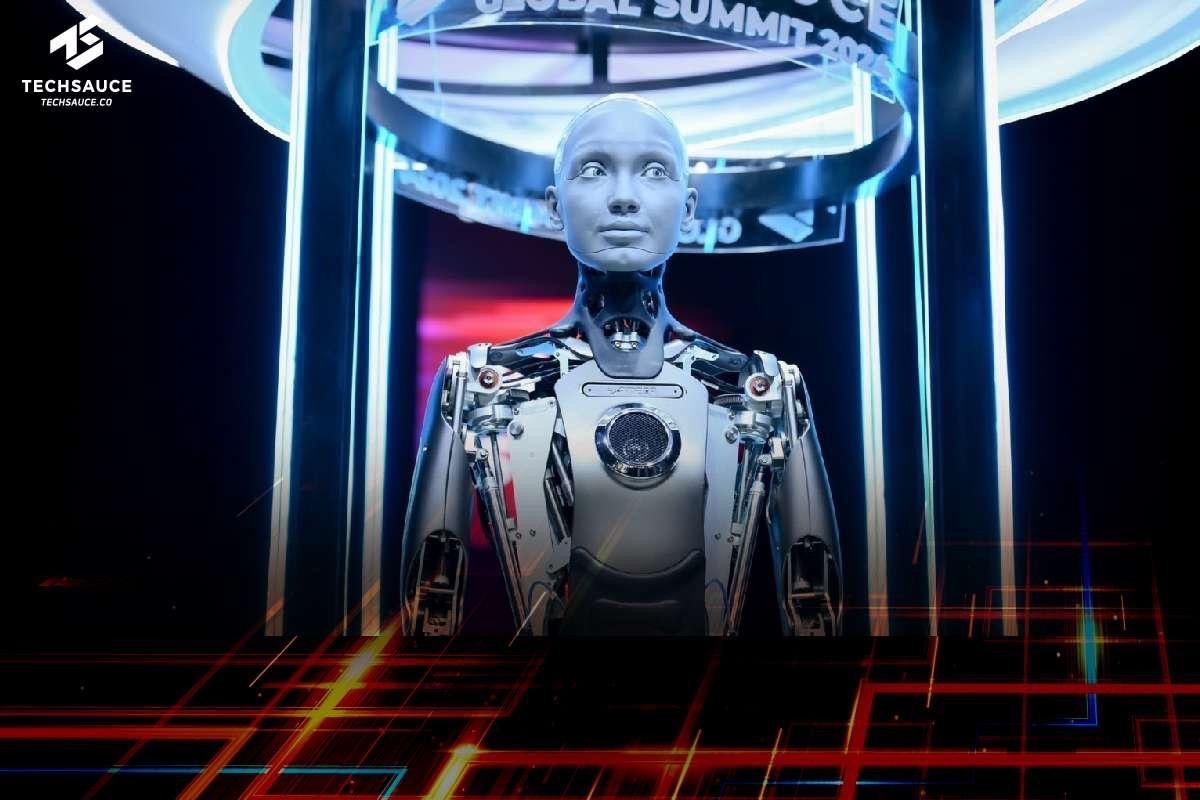
Credit: TECHSAUCE
From a Manufacturing Base to an Embodied AI Ecosystem
Embodied AI differs from AI that operates solely on a screen or within a software environment. This form of artificial intelligence must be able to perceive its surroundings, make decisions and respond to the physical world through the “body” of a machine or robot.
The technology therefore extends well beyond the AI model itself. It must work in concert with motion systems, machine vision, object manipulation, force control, computing and the safety systems required when robots operate alongside people.
Thailand’s advantage lies partly in its existing manufacturing base, which already supports many of these technologies. This includes high-precision metal components, transmission systems, electronics, automotive parts, automation systems and factories with experience in producing to international standards.
According to the Thailand Board of Investment (BOI), investment in humanoid robot components builds on Thailand’s established strengths in industrial component manufacturing and could support the emergence of an advanced robotics and automation cluster in the country.
This is important because no humanoid robot can be built from a single component or by a single company. It depends on a broad network of upstream and downstream businesses. A supply chain capable of producing a wide range of components is therefore a fundamental part of building the ecosystem.
From the Automotive Supply Chain to the Humanoid Supply Chain
One reason the humanoid robotics industry can build on Thailand’s existing capabilities is that many of the required technologies and skills are closely related to the automotive and electronics industries already established in the country.
Modern vehicles rely on drive systems, sensors, electronics, software, control systems and high-precision components. Humanoid robots require many of the same capabilities, although the challenge shifts from controlling a vehicle to controlling arms, legs, joints, hands and far more complex forms of movement.
It is therefore not surprising that some manufacturers traditionally associated with the automotive supply chain are beginning to expand into robot components.
The BOI has stated that promoted projects include planetary roller screws, robot ball screws, actuators, as well as structural and joint components for humanoid robots — all of which are essential parts of robotic motion systems.
Seen in this context, the transition does not mean replacing or abandoning existing industries. It means applying capabilities accumulated over many years to industries with higher technological complexity and greater value.
New Investment Is Laying the Foundations for a Humanoid Cluster in Thailand
A clear signal emerged in early 2026, when the BOI approved investment promotion for five Chinese companies — Hangzhou Seenpin Electromechanical Transmission, Beite Technology, Sanhua Intelligent Drives, Tuopu Technology and Xusheng Group — to manufacture components related to humanoid robots in Thailand.
Combined initial investment exceeds THB 10 billion, covering manufacturing facilities in Chonburi, Chachoengsao and Rayong. The projects range from high-precision transmission components and actuators used to control robot joints to structural components for humanoid robots.
The BOI expects these projects to create more than 1,000 high-skilled jobs for Thai workers and generate annual demand for domestically sourced raw materials and components worth more than THB 45 billion.
These figures represent more than the addition of five new factories. What is beginning to take shape is a concentration of multiple activities across the supply chain within the same industrial region.
Once major component manufacturers establish production bases, they can create further opportunities for raw-material suppliers, machinery manufacturers, engineering service providers, testing-system specialists and other related businesses to enter the ecosystem.
This is particularly significant because much of the investment is concentrated in Thailand’s Eastern region, where automotive, electronics, logistics and infrastructure industries are already well established.
The humanoid supply chain therefore does not have to start from an empty industrial landscape. It can build on an industrial ecosystem that already exists.
Hardware alone, however, is still not enough to constitute an Embodied AI ecosystem.
From Hardware to Intelligence
The next stage of the industry is to enable robots to “perceive, think and act” in real-world situations.
Modern robots must combine data from cameras, sensors and control systems with AI so that they can understand their surroundings, plan movements, interact with people and adapt their behaviour to changing conditions.
This shift requires the ecosystem to expand beyond component manufacturers. It must also include AI technology companies, software developers, system integrators, cloud infrastructure, data platforms and businesses capable of testing and deploying robots in real commercial environments.
Thailand is beginning to see signs of this type of activity as well.
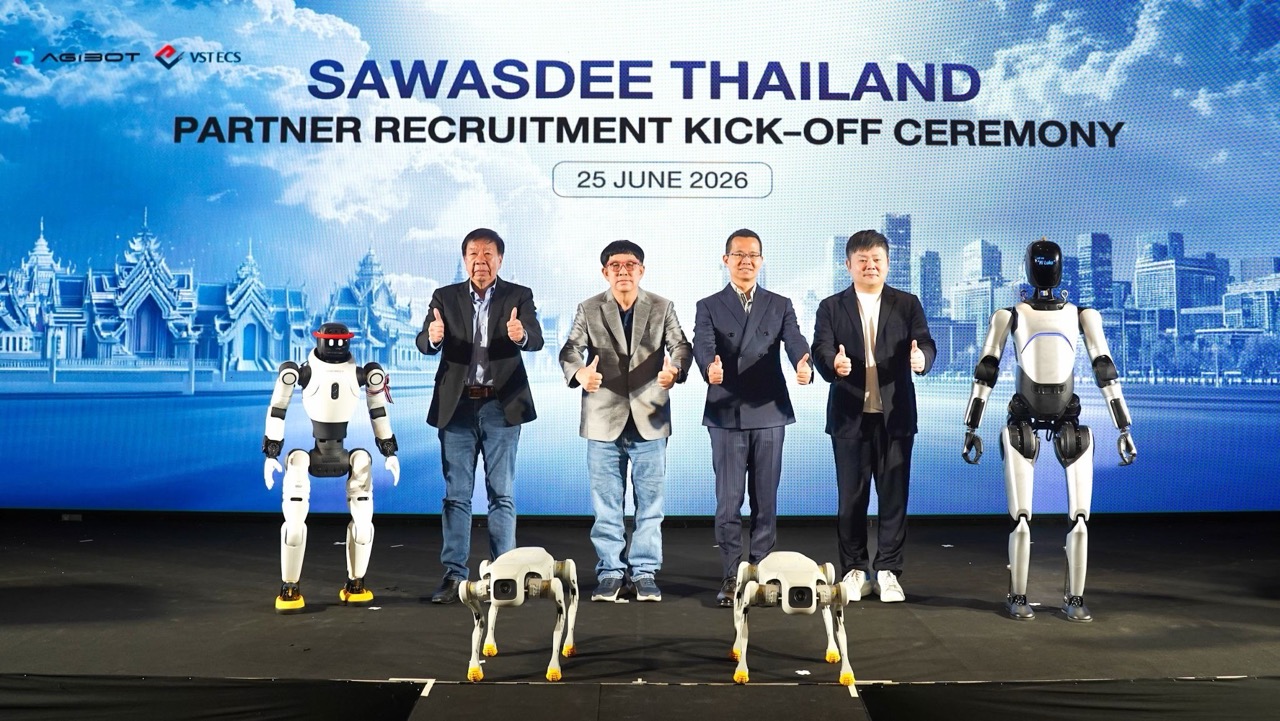
One example is the AGIBOT Partner Conference 2026 Thailand held in Bangkok, where a partner network was introduced to support the practical deployment of Embodied AI and humanoid robots across a range of industries. The initiative also included cooperation with local system integrators to develop solutions tailored to specific applications.
This example should be seen as one of several market signals rather than evidence that Thailand’s ecosystem depends on any single company.
The larger challenge is to create an environment in which multiple technology developers can work with factories, hospitals, service centres, logistics operators, retailers and other businesses to develop use cases that can be tested and validated in real-world settings.
Credit: AGIBOT
This is where the idea of “Intelligence in Thailand” begins to take on greater meaning.
Thailand can create more value when its role extends beyond manufacturing the robot itself to include developing, testing, integrating and deploying the technology in practice.
The Strength Lies in Connecting the Ecosystem
Competition in humanoid robotics and Embodied AI cannot be measured simply by the number of factories or robots.
Countries with the potential to grow in this field need to bring multiple elements together — precision manufacturing, electronics, semiconductors, automation, AI, software, research, talent and markets that are ready to test emerging technologies.
For Thailand, these elements are directly connected with the focus industries prioritised by TCEB, including Digital, AI & Intelligence Technology, Semiconductor & Smart Electronics and Advanced Manufacturing.
These sectors form part of TCEB’s approach to turning Thailand’s industrial strengths into competitive advantages for attracting international Business Events.
The relationship among these industries also makes humanoid robotics a compelling example of cross-industry innovation.
A single humanoid robot can bring together chips, sensors, AI systems, automotive components, control software and advanced manufacturing technologies within one integrated platform.
If Thailand can continue to strengthen links among manufacturers, investors, researchers, technology developers and end users, its competitive advantage will not rest on manufacturing cost alone. It will also come from its ability to bring different technologies together and turn them into new products and services.
When an Industry Ecosystem Becomes a MICE Ecosystem
This is where humanoid robotics and Embodied AI connect directly with the MICE industry.
Global organisers of conferences and exhibitions do not choose host countries on the strength of convention centres alone. This is particularly true for technology events, where participants increasingly look for destinations with an established industry base, active investor networks, technology developers and opportunities for collaboration beyond the event itself.
Thailand already has strong foundations in automotive, electronics, automation and advanced manufacturing, while investment in humanoid components, AI and embodied robotics is increasing.
These developments strengthen Thailand’s case as a destination for international robotics and automation events.
This connection is already becoming visible in the MICE market. Intelligent Asia Thailand 2026, for example, brings together the electronics, PCB, automation and smart manufacturing industries.
Thailand also continues to host activities related to automation and logistics technology.
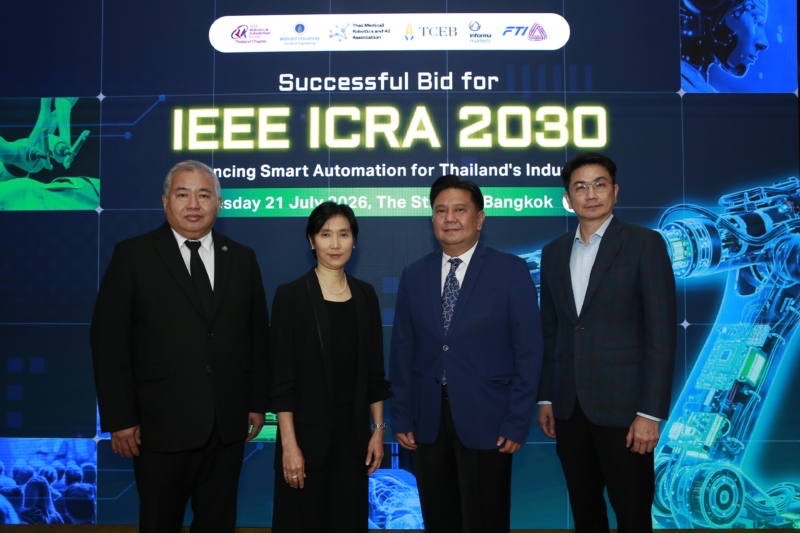
An even more significant milestone is Thailand’s successful bid to host the IEEE International Conference on Robotics and Automation 2030, or IEEE ICRA 2030, for the first time.
The event is expected to attract approximately 10,000 researchers, specialists and industry representatives.
TCEB positions the conference as more than an academic gathering. It is intended to serve as a Strategic Economic Platform that brings together research, technology, investment and the robotics, AI and automation industries.
Securing an event of this level illustrates how the industry ecosystem and the MICE ecosystem can reinforce one another.
A strong industrial base strengthens a country’s ability to attract highly specialised international events. At the same time, when global events come to Thailand, researchers, investors, manufacturers and technology developers from around the world are able to experience the country’s ecosystem first-hand.
This can lead to knowledge exchange, business matching and new collaboration, which in turn can help accelerate further industrial development.
How MICE Can Accelerate the Ecosystem
The value of robotics or Embodied AI events therefore extends beyond visitor numbers or event revenue.
For Trade, exhibitions can connect Thai component manufacturers with robot developers, machinery manufacturers and international buyers.
For Investment, conferences and exhibitions allow investors to meet government agencies, industrial estates, businesses and relevant supply-chain partners within a single trip.
For Knowledge, Thailand can bring global expertise in robotics, AI, human-robot interaction, automation and safety standards closer to Thai researchers, engineers and businesses.
For Talent, the presence of international experts gives Thai students, engineers, software developers and professionals opportunities to learn directly from the industry and build professional networks.
This is why MICE should not be seen only as something that follows after an industry has already grown.
It can also serve as a mechanism that helps accelerate the growth of the ecosystem itself.
From “Made in Thailand” to “Intelligence in Thailand”
Thailand is still at an early stage in developing its humanoid robotics and Embodied AI ecosystem.
The road ahead will require continued development in talent, research, digital infrastructure and safety standards, as well as stronger integration of Thai businesses into global supply chains and the creation of use cases that can demonstrate the value of these technologies in real-world settings.
MICE does more than bring “people” into the country. It also brings “knowledge” into the ecosystem.
When Thailand hosts international conventions, Business Forums, exhibitions or Business Matching activities, participants bring more than travel spending.
They also bring knowledge, technology, new ideas, expert networks and business opportunities.
What is happening today points to an important direction: Thailand is moving from a country known primarily for “manufacturing” towards one that has greater opportunities to participate in the stages of “development, system integration, testing and deployment”.
When high-precision manufacturing is connected with electronics and semiconductors, factories with automation, automation with AI, and AI with real-world applications, Thailand can create value beyond hardware alone.
It can move further into more sophisticated segments of the value chain.
As these ecosystems develop, Thailand will also gain new reasons to attract international conferences, exhibitions, technology competitions, academic congresses and Business Events related to robotics, AI and advanced manufacturing.
The concept of “Thailand as an Emerging Humanoid & Embodied AI Ecosystem” is therefore not a declaration that Thailand has already become a global robotics hub.
Rather, it reflects the opportunities emerging from strengths that are increasingly being brought together — the manufacturing base, new investment, technology, talent, real-world applications and international MICE platforms.
The transition from “Made in Thailand” towards “Intelligence in Thailand” could therefore represent another important step in Thailand’s development, as manufacturing capability expands beyond producing components into knowledge, innovation and technologies designed to operate in the real world.
As the world looks for destinations for international events, the question is no longer simply, “Does Thailand have good event venues?”
The more important question is, “What can participants connect with when an event is held in Thailand?”
Thailand’s answer lies in its ability to bring together the MICE industry, knowledge, innovation and investment.
Building on the global recognition of “Made in Thailand”, the country is moving towards “Intelligence in Thailand” — not only as a place that produces goods and services for the world, but as a place where people, knowledge, technology and opportunities from around the world can come together to create new possibilities and grow together.
Because MICE events held in Thailand do not have to end when the event itself concludes.
They can leave behind knowledge, connections, collaboration and business opportunities that continue to develop over the long term.