IMF–World Bank 2026: How Thailand Secured the Hosting Rights After 35 Years and Returned to the Global Financial Stage
Thirty-five years after first hosting the event, Thailand welcomed the IMF–World Bank Annual Meetings 2026 once again, demonstrating the country’s capacity to host world-class international conferences and highlighting the role of the Meetings, Incentives, Conventions and Exhibitions (MICE) industry in creating economic opportunities.
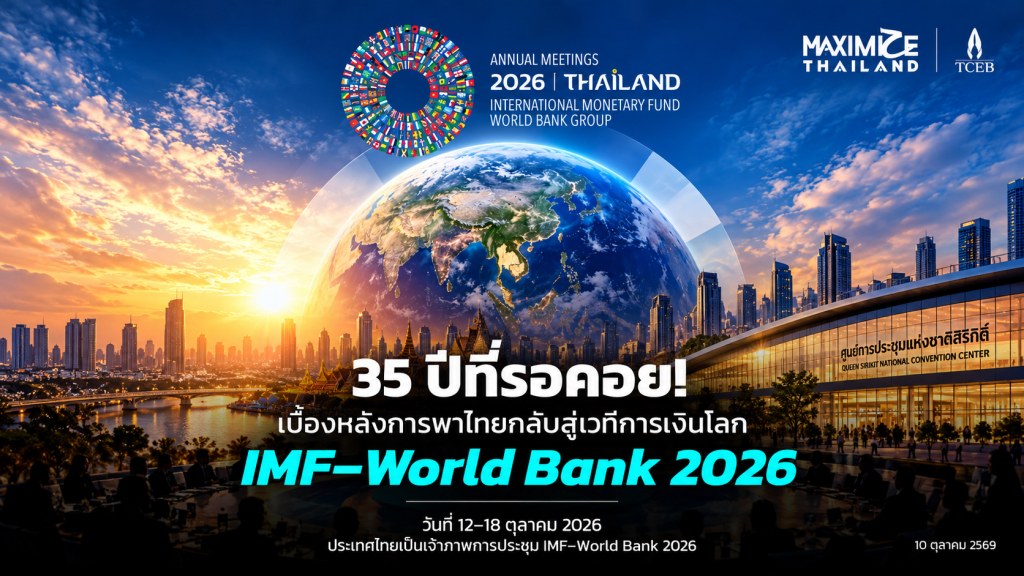
The 2026 Annual Meetings of the International Monetary Fund (IMF) and the World Bank Group, known as the IMF–World Bank Annual Meetings 2026, took place from 12–18 October 2026 at the Queen Sirikit National Convention Center (QSNCC), Bangkok. The event brought together representatives from 191 countries, with attendance projected to exceed 15,000 participants.
The Annual Meetings represent one of the world’s major platforms for economic, financial, and development leaders to discuss the direction of the international economy amid growing economic and geopolitical uncertainty.
However, Thailand’s return as host did not happen overnight. It was the result of years of preparation, a competitive international bidding process, and coordinated efforts among multiple stakeholders that helped bring Thailand back to the global financial stage.
From 1991 to 2026: Thailand Hosts the IMF–World Bank Annual Meetings Again After 35 Years
In 1991, Thailand hosted the IMF and World Bank Annual Meetings for the first time. This marked a major milestone in the country’s international conference industry and was among the driving forces behind the development of the Queen Sirikit National Convention Center to accommodate the historic event.
Thirty-five years later, Thailand returned as host in 2026, against a significantly different global backdrop characterised by geopolitical tensions, economic volatility, and growing challenges related to sustainable development.
Hosting the meetings again was therefore more than a return to a prestigious international event. It provided an opportunity for Thailand to demonstrate its infrastructure capabilities, expertise in managing large-scale conferences, and readiness to welcome high-level delegates from around the world.
Behind Thailand’s Successful Bid to Host the IMF–World Bank Annual Meetings 2026
Thailand’s journey towards hosting the meetings began in 2021, when the Thailand Convention and Exhibition Bureau (TCEB) initiated efforts to position the country as a candidate for the IMF–World Bank Annual Meetings 2026.
The bidding process required a comprehensive assessment of multiple factors, including conference venues, infrastructure, transportation networks, security arrangements, and the country’s capacity to accommodate a large number of international delegates.
From an initial shortlist of five countries, the selection process narrowed to three finalists, before Thailand was officially selected as host in 2023.
This achievement demonstrates that attracting world-class conferences requires more than suitable venues. It depends on international confidence in a country’s overall capabilities and the ability of relevant organisations to work together effectively.
Team Thailand and TCEB’s Role in Securing a World-Class Conference
One of the key factors behind Thailand’s successful bid was the collaboration under Team Thailand, involving the Ministry of Finance, the Bank of Thailand, TCEB, and other relevant partner organisations.
Throughout the process, TCEB played a significant role as the National Bidder, from initiating the proposal and contributing to the bid preparation to coordinating stakeholders and presenting Thailand’s readiness to the selection committee.
This cooperation extended beyond securing the hosting rights. It also involved preparing for the complex operational requirements of a major international conference, including event management, service delivery, and compliance with international conference standards.
The journey from the initial proposal in 2021 to the successful hosting of the event in 2026 illustrates the importance of coordinated efforts between government agencies and partner organisations in achieving shared national objectives.
How Did the IMF–World Bank Annual Meetings 2026 Create Economic Opportunities for Thailand?
Hosting a major international conference creates opportunities that extend beyond the event venue, with the potential to generate economic benefits across a wide range of related industries.
The arrival of delegates from around the world stimulates demand for services including hotels and accommodation, airlines, transportation, restaurants, hospitality services, and local businesses.
Beyond spending generated during the event, international meetings also provide opportunities to strengthen international relationships, exchange knowledge, and develop professional networks among government leaders, business representatives, and international organisations.
At the same time, hosting an event of this global significance allows Thailand to showcase its capabilities as an international conference destination and strengthen long-term confidence in the country’s capacity to deliver major international events.
The MICE Industry’s Role in Driving Economic Development and National Competitiveness
The IMF–World Bank Annual Meetings 2026 demonstrate that the MICE industry (Meetings, Incentives, Conventions and Exhibitions) plays a role far beyond organising events and accommodating participants.
International conferences can serve as platforms connecting people, knowledge, businesses, and economic opportunities, particularly when they bring together policymakers and leaders from different countries.
Attracting events of this scale contributes to strengthening Thailand’s MICE industry competitiveness while enhancing the country’s international reputation and credibility.
For TCEB, promoting Thailand as a host destination for world-class events is therefore not simply about increasing the number of events held in the country. It is also about generating economic value, supporting industry development, and elevating Thailand’s position on the international stage.
From 1991 to 2026, the 35-year interval represents more than the time between Thailand’s two opportunities to host the IMF–World Bank Annual Meetings. It also reflects the country’s development as a destination capable of accommodating major global conferences.
Behind this achievement were sustained preparations and the collective efforts of Team Thailand, which transformed the bid into a shared national success.
The IMF–World Bank Annual Meetings 2026 were therefore more than an opportunity to welcome global economic and financial leaders. They marked another important milestone demonstrating how the MICE industry can connect Thailand with future economic opportunities and international cooperation.