
Future-Ready Economy 2026: Five Key Dimensions for Building Thailand’s Future-Ready Economy
Economic growth alone may no longer be sufficient to define a country’s development. In an increasingly uncertain world, economic success is not determined solely by how rapidly GDP expands. It must also be measured by the opportunities created for people, the country’s competitiveness, and its ability to adapt to future changes.
Amid geopolitical tensions, rapid technological advances and artificial intelligence (AI), energy market volatility, and climate change risks, building a Future-Ready Economy requires a perspective that extends beyond short-term economic growth.
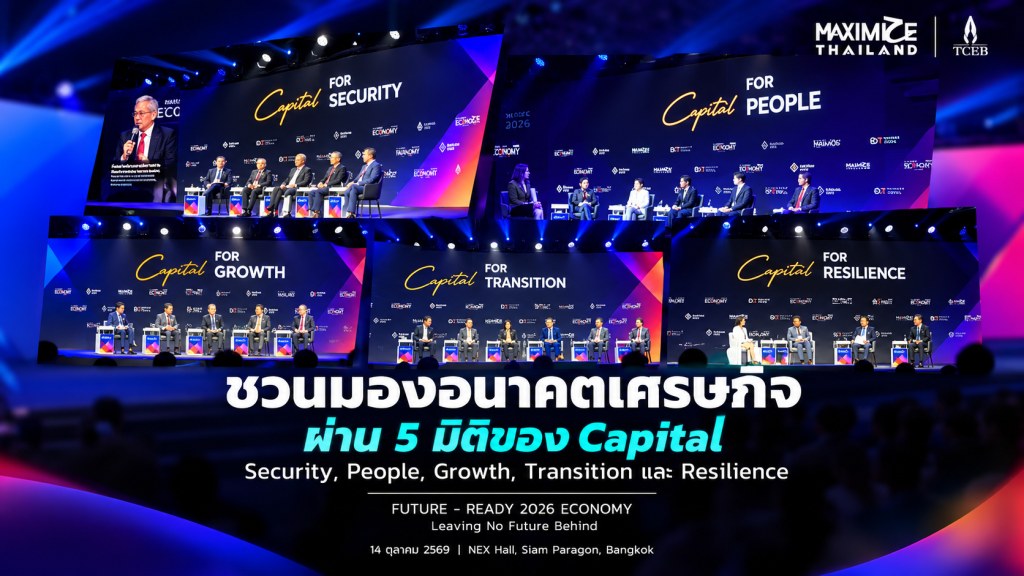
This concept was at the heart of FUTURE-READY 2026 ECONOMY: Leaving No Future Behind, held on 14 October 2026 at NEX Hall, Siam Paragon, Bangkok. The event brought together experts from government, business, financial institutions, and international organisations to exchange perspectives on the future of the economy.
A central theme of the discussions was the examination of economic development through five dimensions of capital: Capital for Security, Capital for People, Capital for Growth, Capital for Transition, and Capital for Resilience. Each dimension serves a distinct purpose, yet all are interconnected in building an economy that is secure, competitive, and inclusive.
What Is a Future-Ready Economy, and Why Does It Matter to Thailand?
A Future-Ready Economy is an approach to economic development that prioritises long-term growth and the ability to adapt to changing circumstances.
Traditionally, economic success has often been assessed through indicators such as GDP growth, exports, and investment. However, as the global economy faces increasingly complex risks, growth alone may not fully reflect a country’s preparedness for the future.
An expanding economy may still be vulnerable due to excessive dependence on particular markets, shortages of skilled workers, or infrastructure that is not equipped to support emerging technologies and industries.
Building a future-ready economy therefore requires simultaneous progress across several areas, including economic security, human capital, competitiveness, sustainable transition, and crisis resilience.
These five dimensions formed the foundation of discussions at Future-Ready Economy 2026.
1. Capital for Security: Strengthening Economic Security by Reducing Risks and Expanding Options
As geopolitics increasingly influences trade, investment, and international relations, Economic Security is no longer simply about protecting an economy from external threats. It also involves strengthening the ability to adapt when global circumstances change.
International conflicts, shifts in trade policies, and supply chain uncertainty all affect economic decision-making by governments and businesses.
In this environment, relying heavily on a limited number of markets, sources of raw materials, or economic partners can increase vulnerability when unexpected disruptions occur.
Strengthening economic security therefore requires diversifying economic relationships, reducing excessive dependence on individual sources, and maintaining investor confidence.
For Thailand, this highlights the importance of expanding economic options and preserving policy flexibility, enabling the country to respond more effectively to uncertainty in the global economy.
2. Capital for People: Investing in People as the Foundation of the Future Economy
Technology and AI are continuously transforming the nature of work and the skills required by the labour market. However, access to advanced technology alone does not guarantee that everyone will benefit from these changes.
The foundation of Capital for People is the development of Human Capital, ensuring that individuals can adapt, continue learning, and access emerging economic opportunities.
Investment in people must extend beyond formal education to include workforce skills development, lifelong learning, and opportunities for entrepreneurs to develop and expand their businesses.
At the same time, building an inclusive economy requires consideration of those facing economic barriers, including providing opportunities for individuals who have experienced setbacks to rebuild their livelihoods.
For Thailand, workforce development and equitable access to opportunities are essential to preparing for technological advances and evolving business models.
If economic growth is driven by new technologies while significant segments of society lack access to the necessary skills and opportunities, the benefits of growth may not be widely shared.
3. Capital for Growth: Building Long-Term Competitiveness Beyond GDP Expansion
GDP growth remains an important economic indicator, but it does not fully explain whether a country is establishing the foundations for sustainable future growth.
The central objective of Capital for Growth is therefore not merely to expand the economy, but to strengthen competitiveness and continuously improve productivity.
Examples from technology-driven economies such as Taiwan and South Korea demonstrate that developing industrial capabilities requires sustained investment and long-term commitment.
One of the key frameworks presented was the 3I approach: Investment, Infusion, and Innovation.
- Investment: Allocating resources to strengthen economic foundations and enhance production capabilities.
- Infusion: Adopting existing technologies, knowledge, and established practices to improve efficiency and productivity.
- Innovation: Developing new innovations to generate added value and strengthen competitiveness.
These three components are closely interconnected. Investment alone may not be sufficient if businesses cannot effectively adopt technologies or develop new capabilities.
Another important priority is creating an environment that supports the growth of small and medium-sized enterprises (SMEs), enabling promising businesses to expand, increase productivity, and play a more significant role in the economy.
4. Capital for Transition: Unlocking Finance for a Sustainable Economic Transformation
Transitioning towards a sustainable economy requires substantial investment. However, the challenge is not simply to mobilise more capital.
The key objective of Capital for Transition is ensuring that available financial resources can reach projects capable of delivering meaningful transformation.
From an investment perspective, one major obstacle is the shortage of investable projects—initiatives that demonstrate sufficient feasibility, potential returns, and effective risk management to attract investment.
Investors also require clear policies, stable regulations, and reliable, verifiable information to support their decisions.
This challenge is particularly evident in the Energy Transition, which cannot be achieved solely by expanding renewable energy generation capacity.
Investment must also address electricity grids, transmission and distribution networks, energy storage systems, and system flexibility to ensure that clean energy can be integrated efficiently.
Furthermore, the transition must not be limited to large corporations. SMEs often face constraints related to financing, technical knowledge, and access to the information needed to adapt.
The development of a Carbon Calculator for small businesses in Thailand illustrates how making environmental measurement and monitoring more accessible can help smaller enterprises participate in the transition.
Another important concept is the relationship between the Capital Gap and the Trust Gap. When investors lack credible information or cannot adequately assess project readiness, capital may remain uninvested even when financing needs are substantial.
5. Capital for Resilience: Investing in Preparedness Before Crises Occur
When disasters or economic crises occur, financial resources are often mobilised to provide immediate assistance and restore damaged infrastructure. Yet investment in prevention and preparedness may receive comparatively less attention.
This is the starting point of Capital for Resilience, which calls for a shift from Financing Disaster Response to Investing in Resilience.
One example illustrates this challenge: securing a budget to repair a damaged bridge after a disaster may be easier than obtaining funding for preventive maintenance before damage occurs.
Building resilience therefore requires political commitment and the integration of crisis preparedness into national budgets and investment plans.
In the financial sector, instruments such as Parametric Insurance, Credit Guarantees, and Sovereign Risk Financing can help governments, individuals, and businesses manage risks and access financial resources more effectively during crises.
For businesses, resilience also involves maintaining operations and employment amid fluctuations in energy costs, while adopting technology and AI to improve production efficiency.
At the same time, modern risks increasingly extend beyond national borders. Strengthening preparedness therefore requires international cooperation, including information sharing, early warning systems, and financial mechanisms to support emergency responses.
How Do the Five Dimensions of Capital Work Together to Build a Future-Ready Economy?
Although each dimension addresses a different economic challenge, all five are closely connected.
- Capital for Security strengthens economic stability and expands strategic options amid global uncertainty.
- Capital for People develops human capabilities and enables people to access opportunities created by emerging technologies and industries.
- Capital for Growth establishes new engines of economic growth through investment, technology adoption, and innovation.
- Capital for Transition supports the shift towards a sustainable economy by improving access to finance and creating an enabling investment environment.
- Capital for Resilience enhances crisis preparedness and reduces long-term economic vulnerability.
These five dimensions cannot be developed in isolation. Economic growth depends on capable people, investment requires confidence, sustainable transitions need supporting systems, and competitiveness must be maintained even during periods of disruption.
Together, they provide a framework for building a Thai economy that is not only capable of growing, but also adaptable, inclusive, competitive, and prepared for the future.